Another Week Beyond – 2223

Dear friends,

11 youth were introduced to the concepts of self-regulation, triggers, trauma responses and coping mechanisms as they trekked the Southern Ridges last Friday. Agreeing to only use their phones for photographs, they endeavoured a mindful beginning where they practiced being aware of their breathing, the manner in which they were walking as well as the healing presence of nature around them.  They had not imagined that a walk could be anything more than a physical activity to get around and most importantly, how it may surface an ableism they have not been aware off.

Ableism is a prejudice, bias, or discrimination toward those living with disabilities but in this case, those struggling with the physical demands of the trek. Hence, their mindful beginning also included a commitment to stick together throughout the entire walk so that no one was made to feel that they were ahead or left behind.

When they reached their first checkpoint, they rested by stretching and trying out techniques for relieving stress. To release tension, they tried shaking their hands and self-massaging their head and the technique of hugging oneself aptly led the group to discuss self-care. The discussion began by identifying what triggered strong emotions that affected one’s mental health. An ex-boyfriend, criticism at work and interestingly, sensing that another person was being bullied were some examples of triggers.

Many did not reveal what triggered them, but they were not short of examples when asked to list what they considered to be healthy and unhealthy ways of coping. It was concerning to hear about different examples of self-inflicted pain as a method of coping, but it was assuring that there was much awareness of healthy coping behaviours such as exercise, talking it out, listening to music and such.  It appeared that the youth had a propensity for both healthy and unhealthy coping behaviours and the mutual support we are encouraging could steer them toward the healthy options.

There were 2 other checkpoints before the walk ended and participants were introduced to an overview of the trauma responses of fight, flight, freeze and fawn.  The youth identified their favoured response and reflected on how they have come to adopt them. Of course, no one can be certain about the root causes of their preferred response but being able to imagine habits as the result of certain conditions meant that one could also intentionally create the conditions to develop new coping habits. The thought that one could replace an unhelpful habit with a more helpful one was encouraging.

Inclusive of the learning at checkpoints, the entire walk took 6 hours and participants went home pondering on the notion of strength. Strength is not just physical fitness but the ability to be comfortable and welcoming of the sensations of discomfort that are constantly unfolding before us. Also, although our programme is called HeadStrong, mental health and wellness is not an exercise in “mind over body” but is achieved when the mind and body connect harmoniously for comfort and wellbeing.

For peace, community, and holistic health,

Sincerely,

Gerard

A walk-in nature, walks the soul back home. – Mary Davis
PAST AWB POSTS

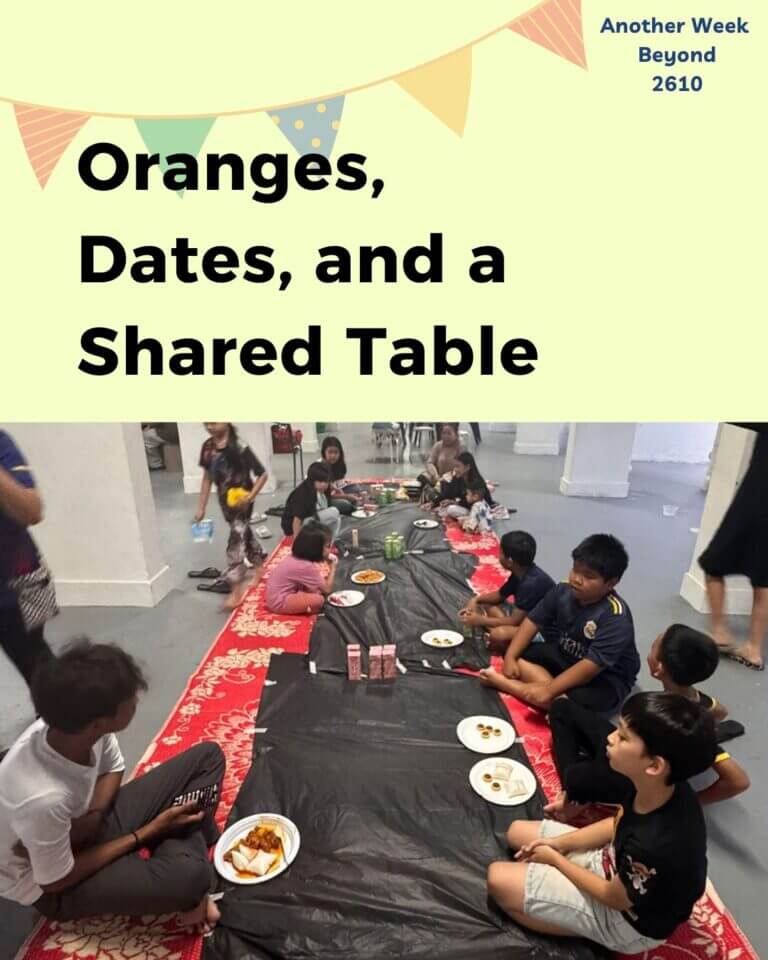
2610 – Oranges, Dates, and Party Plates

Story Contributed by Dira, Neighbourhood Leader Some evenings come together in unexpected ways. Our monthly community birthday celebration in Ang Mo Kio happened to fall at a time when Chinese New Year was still in the air and Ramadan was already underway. So the evening became a mix of all three – oranges for the New Year, dates for those breaking fast, and party plates laid out for the children celebrating their birthdays that month. Close to a hundred residents – seniors, adults and children – came downstairs to join the gathering. A few of us residents helped organise the

Read More »

2609 – How We Spend Our Time

Story contributed by Anne Marie, Resource Mobilisation It has been some years since we last stood behind a volunteer recruitment booth in a school setting, and so earlier this month, when we were invited to take part in Nanyang Technological University’s Social Impact Week, it felt like a return of sorts. For two afternoons, we found ourselves in the middle of student activity, surrounded by clubs, social enterprises and fellow agencies. We were there with a simple invitation: to talk about volunteering, particularly in support of the older youths in our academic programmes. At our booth, we asked visitors to

Read More »

2608 – Holding The Middle

Written by The Beyond Editorial Team She has always cared for others. Long before we knew her, Mdm Sng* was already checking in on elderly neighbours, helping them navigate services, passing along information, gathering what they needed. When we began working in the area, she reached out quickly. Not for herself. For others. Over time, though, something shifted. There was no single incident. Just the quiet accumulation of strain. Our team had become leaner. Priorities evolved. Expectations were not always spoken clearly. Along the way, misunderstandings surfaced. Community tensions are rarely linear. They sit in the middle of relationships –

Read More »

2607 – Refreshing Our Purpose

Story Contributed by Shariffah, Community Worker In January, we gathered again in a familiar circle. Since then, three Capability Building sessions have brought together 26 Neighbourhood Leaders and Community Volunteers from three neighbourhoods. It was not a workshop in the traditional sense. It was a space to pause, reflect and ask ourselves what kind of community we are shaping together. The most recent session, Refreshing Our Purpose, did exactly that. It slowed the momentum of activity and returned us to the questions underneath the work: What are we building? For whom? And how do we know it is truly shared?

Read More »

2606 – Still Here

As shared by Daybet, Former Beyond Youth Twenty years had passed since Daybet last walked through the doors of Beyond’s office. The space felt smaller than he remembered, but not unfamiliar. Before he could fully take it in, he saw a face that pulled him straight back into memory. “Uncle George!” George paused. It took a second. Then recognition landed – fittingly, on the very day he marked 23 years of working at Beyond. What followed was the easy rhythm of reunion: updates exchanged, laughter over half-forgotten details, stories filling in the years that had slipped by. “You remember Daybet?”

Read More »

2605 – It Takes Time

Written by Wilson, Community Worker I first met Jamie* early last year. She sat close to her mother and said very little. When I asked her questions, her mother often answered first, then turned to Jamie to check if she wanted to add anything. Jamie listened carefully, nodding, offering short replies when she felt able to. Her mother had approached us for support because Jamie was no longer in education or employment. Since leaving school, Jamie spent most of her time at home. Apart from attending school previously, she rarely went out, and once that routine ended, her days became

Read More »

2604 – When Learning is Small Enough to Notice

Story Contributed by Jie Ying, Community Worker Last Saturday, we gathered to mark the end of a small Early Learning Programme class at Lengkok Bahru. The class began in June last year with seven children. Over time, some families moved on as needs shifted and priorities changed. By January, three children remained. We did not see this as a shortcoming. Community work often teaches us that participation ebbs and flows, and that small numbers are not a sign of failure but an invitation to pay closer attention. With fewer people in the room, there is more to notice. Parents sat

Read More »

2603 – When Youths Take the Field

Story Contributed by Yik, Resource Mobilisation In December last year, a small group of children gathered at Delta Sports Centre for a football session. There were six of them, between four and nine years old. One of the youngest arrived with his mother, staying close as the day unfolded. The session wasn’t run by adults or coaches brought in from outside. It was planned and led entirely by Learning Coaches – youths from the community who already spend their weeks supporting younger children with learning. Over time, these youths have become familiar faces to families, people children listen to and

Read More »

PAST AWB POSTS

2610 – Oranges, Dates, and Party Plates

Story Contributed by Dira, Neighbourhood Leader Some evenings come together in unexpected ways. Our monthly community birthday celebration in Ang Mo Kio happened to fall at a time when Chinese New Year was still in the air and Ramadan was already underway. So the evening became a mix of all three – oranges for the New Year, dates for those breaking fast, and party plates laid out for the children celebrating their birthdays that month. Close to a hundred residents – seniors, adults and children – came downstairs to join the gathering. A few of us residents helped organise the

Read more >

2609 – How We Spend Our Time

Story contributed by Anne Marie, Resource Mobilisation It has been some years since we last stood behind a volunteer recruitment booth in a school setting, and so earlier this month, when we were invited to take part in Nanyang Technological University’s Social Impact Week, it felt like a return of sorts. For two afternoons, we found ourselves in the middle of student activity, surrounded by clubs, social enterprises and fellow agencies. We were there with a simple invitation: to talk about volunteering, particularly in support of the older youths in our academic programmes. At our booth, we asked visitors to

Read more >

2608 – Holding The Middle

Written by The Beyond Editorial Team She has always cared for others. Long before we knew her, Mdm Sng* was already checking in on elderly neighbours, helping them navigate services, passing along information, gathering what they needed. When we began working in the area, she reached out quickly. Not for herself. For others. Over time, though, something shifted. There was no single incident. Just the quiet accumulation of strain. Our team had become leaner. Priorities evolved. Expectations were not always spoken clearly. Along the way, misunderstandings surfaced. Community tensions are rarely linear. They sit in the middle of relationships –

Read more >