
Another Week Beyond – 2328

Dear Friends,

3 months ago, when we asked 3 mothers what would bring neighbours together, their spontaneous answer was “Food!” One of them is a volunteer who organises the distribution of food drop-offs by the Jamiyah Food Bank, elaborated that food is a way to do good. Every fortnight when the truckful of groceries arrives, 4 to 6 neighbours will help her sort the items in a way that makes it easy for residents to collect. The lack of food is a strain on families that heightens during the school holidays because children ask for food when they are home. However, these mothers also told us that food reminds them of people and festivals, and they very much enjoy preparing a meal.

Soon after that conversation, with rations from the Jamiyah Food Bank, 2 mothers whipped up a meal at our premises for their families. They also took the opportunity to show 2 other mothers how to prepare the dishes they were serving. Thus, 4 families as well as those of us in the office enjoyed chicken in a spicy coconut gravy and fish in sweet black sauce. It was a joyful experience and the mothers proposed that neighbours could meet regularly to share their recipes.

On Monday, 2 other mothers prepared a meal at a common area near their homes. This time it was a salad with a peanut sauce and a chilli flavoured porridge. 2 older men came by, told the mothers that they were attracted by the aroma and had their fill. Interestingly, a Japanese woman passing by, stopped to watch the mums cooking. She shared that she had just moved to Singapore and was taken by the Malay cuisine. She asked when the next session would be held, and the mothers were excited by the prospect of learning to prepare a Japanese meal from her.

There is now a list of 6 mothers who have agreed to be rostered to share their recipes and they are hopeful that more will join them.
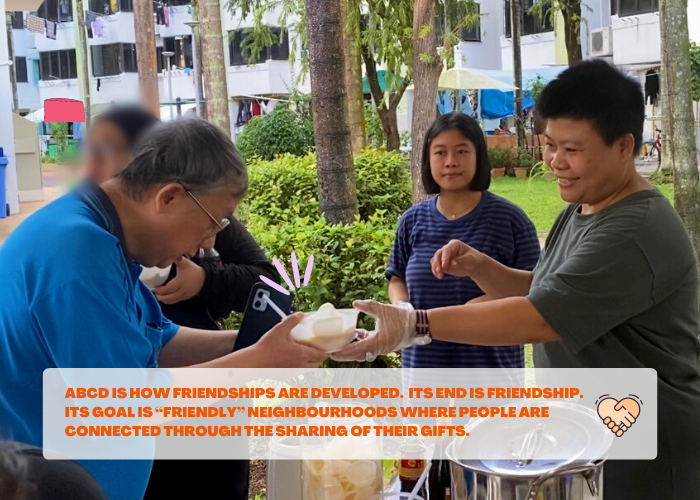
ABCD or Asset Based Community Development is grounded in the principle that everyone has a gift to contribute, and that community is created when people come together to share their gifts. As ABCD practitioners, we facilitate opportunities for people to talk about what brings them joy and while food is always in the frame, it is really a felt connection to a place and its people. ABCD is often touted as a method of community organising to resolve social challenges identified by social service providers but unless the agenda is adopted by the community, nothing much moves.

So as practitioners, we are not a part of the community but as trusted guests, we accompany our hosts respectfully and appreciate the many turns in their journey. The agenda is set by them, and we do our best to be a conduit for the necessary resources.

Food or the need for it is a constant challenge that has come to our attention. It is not so much food for joyful occasions but the assurance that there will be enough on the table for all at home. Your sharing of a meal is much needed and will be much appreciated. Please click on the end banner to share.

For peace and community,

Gerard

Good food is a right, not a privilege. It brings children into a positive relationship with their health, community and environment. — Alice Waters

PAST AWB POSTS

2610 – Oranges, Dates, and Party Plates

Story Contributed by Dira, Neighbourhood Leader Some evenings come together in unexpected ways. Our monthly community birthday celebration in Ang Mo Kio happened to fall at a time when Chinese New Year was still in the air and Ramadan was already underway. So the evening became a mix of all three – oranges for the New Year, dates for those breaking fast, and party plates laid out for the children celebrating their birthdays that month. Close to a hundred residents – seniors, adults and children – came downstairs to join the gathering. A few of us residents helped organise the

Read More »

2609 – How We Spend Our Time

Story contributed by Anne Marie, Resource Mobilisation It has been some years since we last stood behind a volunteer recruitment booth in a school setting, and so earlier this month, when we were invited to take part in Nanyang Technological University’s Social Impact Week, it felt like a return of sorts. For two afternoons, we found ourselves in the middle of student activity, surrounded by clubs, social enterprises and fellow agencies. We were there with a simple invitation: to talk about volunteering, particularly in support of the older youths in our academic programmes. At our booth, we asked visitors to

Read More »

2608 – Holding The Middle

Written by The Beyond Editorial Team She has always cared for others. Long before we knew her, Mdm Sng* was already checking in on elderly neighbours, helping them navigate services, passing along information, gathering what they needed. When we began working in the area, she reached out quickly. Not for herself. For others. Over time, though, something shifted. There was no single incident. Just the quiet accumulation of strain. Our team had become leaner. Priorities evolved. Expectations were not always spoken clearly. Along the way, misunderstandings surfaced. Community tensions are rarely linear. They sit in the middle of relationships –

Read More »

2607 – Refreshing Our Purpose

Story Contributed by Shariffah, Community Worker In January, we gathered again in a familiar circle. Since then, three Capability Building sessions have brought together 26 Neighbourhood Leaders and Community Volunteers from three neighbourhoods. It was not a workshop in the traditional sense. It was a space to pause, reflect and ask ourselves what kind of community we are shaping together. The most recent session, Refreshing Our Purpose, did exactly that. It slowed the momentum of activity and returned us to the questions underneath the work: What are we building? For whom? And how do we know it is truly shared?

Read More »

2606 – Still Here

As shared by Daybet, Former Beyond Youth Twenty years had passed since Daybet last walked through the doors of Beyond’s office. The space felt smaller than he remembered, but not unfamiliar. Before he could fully take it in, he saw a face that pulled him straight back into memory. “Uncle George!” George paused. It took a second. Then recognition landed – fittingly, on the very day he marked 23 years of working at Beyond. What followed was the easy rhythm of reunion: updates exchanged, laughter over half-forgotten details, stories filling in the years that had slipped by. “You remember Daybet?”

Read More »

2605 – It Takes Time

Written by Wilson, Community Worker I first met Jamie* early last year. She sat close to her mother and said very little. When I asked her questions, her mother often answered first, then turned to Jamie to check if she wanted to add anything. Jamie listened carefully, nodding, offering short replies when she felt able to. Her mother had approached us for support because Jamie was no longer in education or employment. Since leaving school, Jamie spent most of her time at home. Apart from attending school previously, she rarely went out, and once that routine ended, her days became

Read More »

2604 – When Learning is Small Enough to Notice

Story Contributed by Jie Ying, Community Worker Last Saturday, we gathered to mark the end of a small Early Learning Programme class at Lengkok Bahru. The class began in June last year with seven children. Over time, some families moved on as needs shifted and priorities changed. By January, three children remained. We did not see this as a shortcoming. Community work often teaches us that participation ebbs and flows, and that small numbers are not a sign of failure but an invitation to pay closer attention. With fewer people in the room, there is more to notice. Parents sat

Read More »

2603 – When Youths Take the Field

Story Contributed by Yik, Resource Mobilisation In December last year, a small group of children gathered at Delta Sports Centre for a football session. There were six of them, between four and nine years old. One of the youngest arrived with his mother, staying close as the day unfolded. The session wasn’t run by adults or coaches brought in from outside. It was planned and led entirely by Learning Coaches – youths from the community who already spend their weeks supporting younger children with learning. Over time, these youths have become familiar faces to families, people children listen to and

Read More »

PAST AWB POSTS

2610 – Oranges, Dates, and Party Plates

Story Contributed by Dira, Neighbourhood Leader Some evenings come together in unexpected ways. Our monthly community birthday celebration in Ang Mo Kio happened to fall at a time when Chinese New Year was still in the air and Ramadan was already underway. So the evening became a mix of all three – oranges for the New Year, dates for those breaking fast, and party plates laid out for the children celebrating their birthdays that month. Close to a hundred residents – seniors, adults and children – came downstairs to join the gathering. A few of us residents helped organise the

Read more >

2609 – How We Spend Our Time

Story contributed by Anne Marie, Resource Mobilisation It has been some years since we last stood behind a volunteer recruitment booth in a school setting, and so earlier this month, when we were invited to take part in Nanyang Technological University’s Social Impact Week, it felt like a return of sorts. For two afternoons, we found ourselves in the middle of student activity, surrounded by clubs, social enterprises and fellow agencies. We were there with a simple invitation: to talk about volunteering, particularly in support of the older youths in our academic programmes. At our booth, we asked visitors to

Read more >

2608 – Holding The Middle

Written by The Beyond Editorial Team She has always cared for others. Long before we knew her, Mdm Sng* was already checking in on elderly neighbours, helping them navigate services, passing along information, gathering what they needed. When we began working in the area, she reached out quickly. Not for herself. For others. Over time, though, something shifted. There was no single incident. Just the quiet accumulation of strain. Our team had become leaner. Priorities evolved. Expectations were not always spoken clearly. Along the way, misunderstandings surfaced. Community tensions are rarely linear. They sit in the middle of relationships –

Read more >